Summary
Small and midsize businesses are often flying blind when it comes to security breach detection. An affordable way to address this issue without the complexity of SIEM is by modeling security events as time series data. This architecture takes audit logs from SaaS platforms and normalizes activities like logins, downloads, and token creation to establish behavior baselines that can be used to detect anomalies indicating security breaches.
Table of Contents
When people hear that the average breach lifecycle still spans hundreds of days, they often blame inefficiency or apathy. The reality is that most teams, especially those in SMBs, are flying blind and relying on logs scattered across dozens of SaaS platforms. The information needed to understand a breach is there, but it often sits behind paywalls or is delivered without enough context to form a coherent picture.
When security events are modeled as time series, they form a continuous stream of behavior rather than isolated snapshots. File downloads, admin actions, and authentication attempts shift from static snapshots to dynamic patterns. Once everything is tracked as a sequence over time, the early signs of trouble become visible far earlier than the consequences do.
Digital Supply Chain Observability
That realization wasn’t theoretical for us. A few years ago, a third-party tool in our pipeline was compromised, and the SaaS didn’t detect it—one of the SaaS’s other customers did. By the time we found out, it was four months since the incident had occurred. That delay made it clear we needed to detect anomalies ourselves, without a full SIEM team or a seven-figure budget.
While that incident wasn’t the sole reason why we did what we did next, it was a catalyst to take security observability into our own hands. We started building an internal monitoring architecture we call DiSCO: Digital Supply Chain Observability. It’s a lightweight, time series-driven system that ingests audit logs from key SaaS platforms we rely on and turns them into an ordered stream of behavior.
The diagram below demonstrates the core idea: small collectors on the left, data collection via Telegraf in the middle, a time series database at the center, and dashboards and alerting tools on the right.
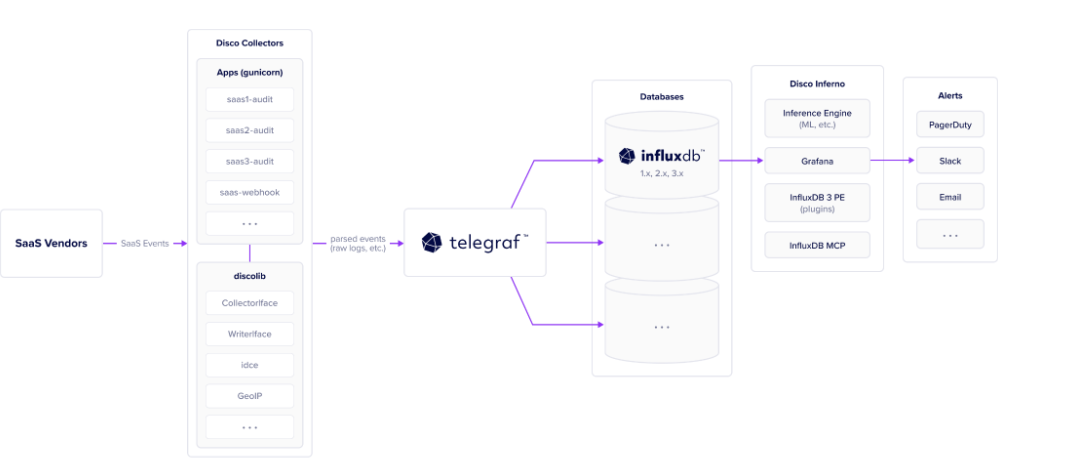
DIY time series security
You don’t need to rebuild DiSCO exactly, but you can build your own version. Here’s a practical path to developing a time series security detection tool without breaking the bank:
Step 1: Map Your Critical SaaS Surface
Start by nominating 5-10 SaaS services critical to your operations or risk profile, such as messaging apps, developer platforms, identity management providers, or financial systems.
Step 2: Secure Access to Audit Logs
Next, determine whether those SaaS tools provide audit logs and what it costs to access them. Many vendors tie log access to higher-priced enterprise plans. While that can feel like a dead end for SMBs, some providers offer off-market plans that include logs without dramatically increasing cost. Continue the conversation and don’t be afraid to negotiate.
If you truly cannot get logs from a particular service, document the gap and revisit it annually.
Step 3: Build Small, Safe Collectors
Once you’ve secured access, you need a way to pull the logs. DiSCO uses a set of small Python applications that:
- Authenticate to each SaaS API using a narrowly scoped, read-only token.
- Pull new audit events on a schedule.
- Hand those events off to a local endpoint for further processing.
You can hand-code these collectors or have an AI system help. Just maintain strict token hygiene: minimal scope, read-only access, and frequent rotation to limit blast radius if a token leaks.
Step 4: Relay Everything Through a Data Collection Agent
Our collectors don’t write directly into the database, but instead send events to a self-hosted Telegraf instance that acts as a buffer and relay. You don’t have to use Telegraf, but its purpose-built support for time series, open source model, and batching capabilities make it a strong option. Events are written into a time series database using line protocol, providing resilience against transient failures.
For storage, you have options:
- A purpose-built time series database optimized for high-ingest, high-cardinality data
- A relational database (expect more overhead as volume grows)
The core requirement is simple: efficient handling of time-stamped events at scale.
Step 5: Design a Schema That Separates Events from Actions
When logs land, DiSCO writes them into three primary tables or buckets:
- A raw logs bucket that stores unmodified SaaS data
- A derived actions table with extracted actor, action, IP address, and country information per origin (SaaS)
- A normalized events bucket that captures behaviors like logins, downloads, token creation, privilege changes, etc.
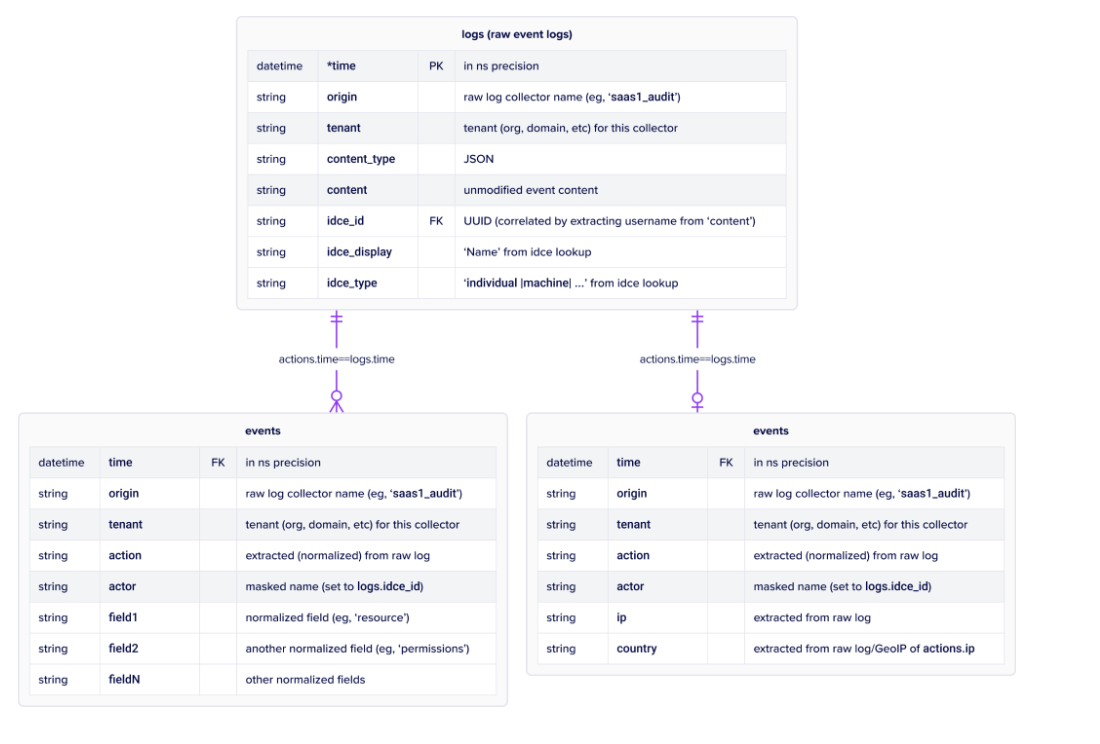
To preserve privacy and simplify correlation, we map user identities to UUIDs before storing them in derived tables. Names remain in raw logs for forensics but are excluded from routine monitoring.
Step 6: Add a Simple Inference Engine
With actions normalized and interleaved by time, you can start asking meaningful questions. DiSCO began with a simple inference engine—essentially SQL queries encoding what normal behavior looks like.
We learned typical login times, countries, IP ranges, and action frequencies, then alerted when behavior deviated from those baselines, such as access from a new or suspicious country.
These are basic signals, but they dramatically shorten detection timelines compared to waiting for vendor notification.
Step 7: Layer on Dashboards and a Time Machine
On top of this, we used Grafana to visualize organization-wide behavior at a glance. Because everything is stored as time series data, you gain a “time machine” that lets you replay historical events after improving parsers or adding new logic.
The point: democratize detection
Most SMBs don’t have the budget or staffing to deploy and operate a full SIEM, but they can access SaaS audit logs, write basic collectors, and use free, open source tooling. That’s enough to build a DiSCO-like architecture and reclaim control over breach detection timelines.
If you want to shorten your breach lifecycle, map your SaaS surface, get the logs, normalize events, and learn what “normal” looks like. Then start asking the only question that really matters in breach detection: What just changed?
You don’t need perfect coverage to get value, but you do need motion. The story of a breach is easier to read when it unfolds on a timeline you can see in real-time.


