Table of Contents
Satellite telemetry monitoring and analytics is the practice of collecting timestamped measurements from spacecraft, ground stations, and network services, then using them to track health, detect anomalies, and diagnose incidents across a fleet. It runs on a telemetry data layer downstream of command and control, and a time series database such as InfluxDB stores the data and serves it to dashboards, alerts, analytics, and AI.
What is satellite telemetry?
Satellite telemetry is the stream of timestamped measurements that describe how a spacecraft, its ground segment, and the network carrying its data are performing.
| Telemetry type | Examples | What it tells operators |
|---|---|---|
| Spacecraft health | Battery voltage and current, temperature, attitude, propulsion | Whether the spacecraft is operating within its limits |
| Payload | Payload instrument readings and status | Whether the payload is performing its mission |
| Ground station | Antenna and ground equipment performance | Whether the ground segment is receiving data reliably |
| Network and service | Network performance, availability of the delivered service | Whether customers are getting the service they expect |
Why use a time series database for satellite telemetry
Time series databases give satellite operators a foundation for managing spacecraft, ground and service telemetry, enabling them to diagnose incidents faster, monitor and analyze system behavior over time, and scale. With this foundation, teams can run satellite services more reliably and efficiently, and reduce risks.
How time series databases support satellite operations
A time series database stores each measurement with its timestamp and source context, making it easier to track changes, correlate related events, and compare telemetry across assets and systems.
The same foundation can support current-state monitoring, historical analysis, and AI workflows. It can also reduce duplicated telemetry infrastructure and help teams investigate issues that span spacecraft, ground, and service systems. As fleets scale, this can lower engineering overhead, speed incident diagnosis, protect service reliability, and reduce operational risk.
Preserve source context in every measurement
Since telemetry comes from spacecraft subsystems, payload instruments, ground station antennas, and the networks carrying data to its destination, these streams need to remain distinguishable while being queryable together.
That’s one of the reasons why time series databases, such as InfluxDB 3 Enterprise, include support for multicardinality and metadata, such as tags, which help identify the source and context of each measurement. For example, with InfluxDB tags in the time series database, a spacecraft power measurement could store:
- Tags for spacecraft ID and subsystem.
- Fields for measured values, such as battery voltage and current.
- A timestamp for when the measurement occurred.
This structure lets an operator select one spacecraft’s power readings during an incident window, then compare equivalent readings across other spacecraft. Consistent tags preserve source identity as more assets are added, helping operators investigate individual systems and compare behavior across the fleet.
Where does InfluxDB fit in the satellite telemetry architecture?
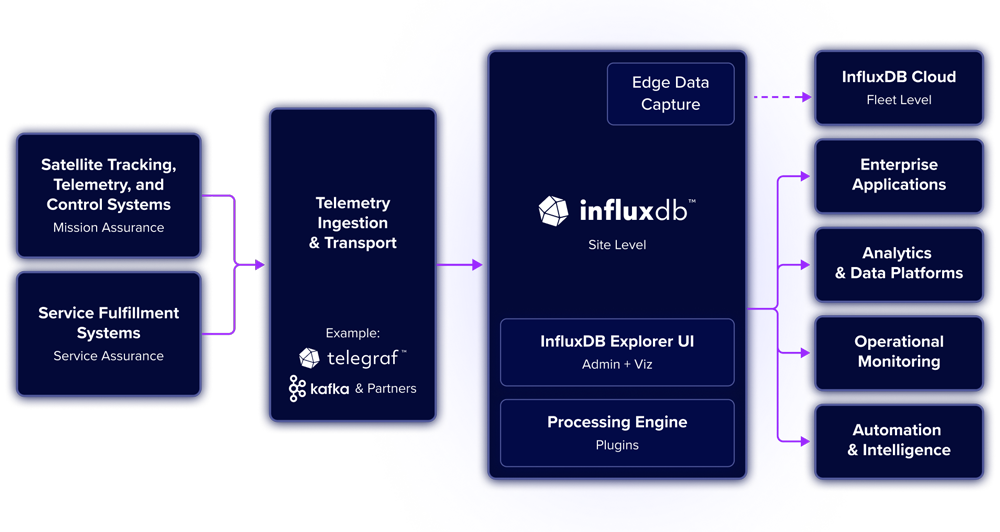
InfluxDB operates downstream of spacecraft and ground control systems, in the telemetry data layer rather than the control plane. Once telemetry has been received and converted into usable, timestamped measurements, InfluxDB stores it and makes it queryable by monitoring dashboards, analytics workflows, applications, and automation systems that all draw on the same underlying time series foundation.
Satellite operations typically separate mission assurance and service assurance. Mission assurance focuses on spacecraft health and mission operation, including tracking and command. Service assurance focuses on the availability and performance of the delivered service, including its supporting ground and network infrastructure.
Mission assurance and service assurance use different tools and operate from separate centers. InfluxDB provides a shared telemetry data layer beneath those workflows. Bringing the telemetry together lets teams correlate spacecraft health with ground and network performance.
How telemetry reaches InfluxDB and is stored
Once spacecraft telemetry has been decoded into timestamped engineering values, it can be collected and written to InfluxDB. Telegraf, InfluxData’s plugin-based collection agent, provides one ingestion path from supported sources, alongside metrics from ground infrastructure and network services.
InfluxDB stores measured values as fields and identifying metadata as tags, e.g., spacecraft ID, subsystem, and ground station. Together with timestamps, these let operators filter, group, and compare telemetry over time. As missions add assets, the number of distinct tag combinations grows, making cardinality an important consideration when sizing the database.
Teams also need to plan how much telemetry detail to retain and for how long. They can retain high-resolution readings for incident investigation and model development, and create downsampled summaries for longer-term trends. Retention determines how long data remains available; downsampling determines how much detail those summaries preserve.
How satellite teams use the telemetry
Because mission and service telemetry share the same time series foundation once they reach InfluxDB, the same underlying data can support several different workloads without duplicating the data itself:
| Workload | What it does |
|---|---|
| Operational dashboards | Show current state across both domains on one time axis |
| Alerting | Flags anomalies as they occur, rather than waiting for a person to notice them |
| Analytics workflows | Look for trends or correlations across historical data that would otherwise sit in separate systems |
| Engineering teams | Validate models against real flight data |
| Automation systems | Trigger actions directly from telemetry conditions |
InfluxData’s satellite telemetry demo illustrates these workloads using a simulated satellite fleet. The InfluxDB 3 Processing Engine evaluates incoming telemetry and generates alerts based on thresholds or sensor states. An AI agent queries telemetry and alerts through the InfluxDB 3 MCP server to help investigate fleet health. The accompanying AI-powered spacecraft operations walkthrough explains how these components work together.
How do you track telemetry changes and correlate events over time?
Telemetry readings are most useful when compared with earlier readings or related measurements from the same time window. Comparing current and prior voltage readings reveals how quickly voltage is changing. Checking whether an attitude shift coincided with a dip in RF performance can help operators investigate the cause of signal degradation.
Answering these questions requires preserving each measurement’s timestamp and source context. Time series databases, such as InfluxDB, let operators query the interval before, during, and after an event, comparing related telemetry streams to identify trends and investigate how an anomaly unfolded.
Using the same telemetry for real-time and historical analysis
From an operations perspective, near real-time access to telemetry supports operational awareness. The use cases are varied ranging from spacecraft health to quality of service, and anomaly detection. Historical telemetry supports analysis, root-cause investigation, fleet comparison (important for constellation operators), and engineering models. AI workflows also draw realtime and historical telemetry. Historical telemetry provides examples for training and evaluating models. Near-real-time measurements supply inputs to deployed models for live anomaly detection and prediction.
Time series databases, such as InfluxDB 3 Enterprise, support both modes with a wide range of features. For example, InfluxDB 3 Enterprise’s Last Value Cache accelerates queries for recent values in selected fields and series. A monitoring application could retrieve current battery voltage readings from the cache, while engineers query historical readings of that same voltage to investigate trends or train and evaluate anomaly detection models.
Why use a shared time series layer instead of separate telemetry stores?
As satellite operations scale, telemetry architecture can affect infrastructure cost, engineering overhead, service reliability, and revenue.
From a cost perspective, separate mission, ground, and service telemetry stores can duplicate ingestion pipelines, storage, integrations, and operational processes. A common time series foundation reduces this architectural sprawl and the engineering effort required to maintain it as fleets and data volumes grow.
From a risk perspective, faults do not necessarily stay within the spacecraft or ground segment. A service issue may involve conditions across both. Time-aligned telemetry helps teams correlate spacecraft, ground-system, and service behavior to isolate the source of an incident faster and restore service sooner. That can reduce exposure to SLA penalties, service credits, customer dissatisfaction, and churn.
Who runs satellite telemetry on InfluxDB?
- Eutelsat OneWeb: real-time telemetry across 600+ LEO satellites, with 1M points ingested per second. Read the customer story.
- LeoLabs: tracking 25,000+ objects in Low Earth Orbit. Read the customer story.
- Loft Orbital: ingests over 500M metrics per day from their fleet of microsatellites. Read the customer story.
For a hands-on view, check out the satellite telemetry on InfluxDB 3 demo.