Summary
Q3 was a packed quarter, with releases across InfluxDB, Telegraf, and Amazon Timestream for InfluxDB that help deployments and fleets grow without slowing down. InfluxDB 3.11 brought performance improvements for heavier, more complex workloads to GA in InfluxDB 3 Enterprise. InfluxDB 3.12 followed with roughly 3x faster bulk imports, distributed compaction in beta, per-database schema enforcement, and generally available role-based access control. Amazon Timestream for InfluxDB gained direct ingestion from AWS IoT Core, custom Python plugins, and eight new regions. Telegraf Controller 1.1 added high availability for Telegraf Enterprise and turned fleet-wide changes into a single edit, and Telegraf 1.40 brought new community contributed plugins.
Here’s a closer look at each release.
Table of Contents
InfluxDB 3.11 brings performance for heavier, more complex workloads to GA
When a system acts on a device’s latest reading or an asset’s current state, query speed decides how fast it can respond, and that gets harder as devices multiply and schemas widen. InfluxDB 3.11, released July 30, made performance improvements built for exactly those workloads in InfluxDB 3 Enterprise. For highly selective queries, like those for a single time series, this release is 4X faster than previous Enterprise 3 releases.
Teams modeling sensor fleets or satellite telemetry can now design schemas around their data, with support for thousands of tables, millions of columns, and ultra-sparse datasets. Memory use also stays steadier under heavy ingest, which makes infrastructure easier to size.
Three new Enterprise capabilities make it safer to protect and clean up production data:
- Backup and restore: full or incremental backups, with asynchronous restores that can roll a live cluster back to an earlier point when you need to
- Bulk import from Parquet: ingest an entire directory of Parquet files directly
- Row-level deletes: remove data by time range or tag predicate without dropping a table
The built-in Explorer UI puts all of this within reach. Teams can query in SQL, InfluxQL, or natural language, convert existing Flux queries to SQL, and manage Processing Engine plugins, all from one unified location.
InfluxDB 3.12 gives growing deployments more capacity and more control
A deployment that’s working tends to attract more of everything: months of backfill, bursty ingest, and more teams writing to the same databases. InfluxDB 3.12 gives operators new ways to handle all of it, and is exclusive to InfluxDB 3 Enterprise.
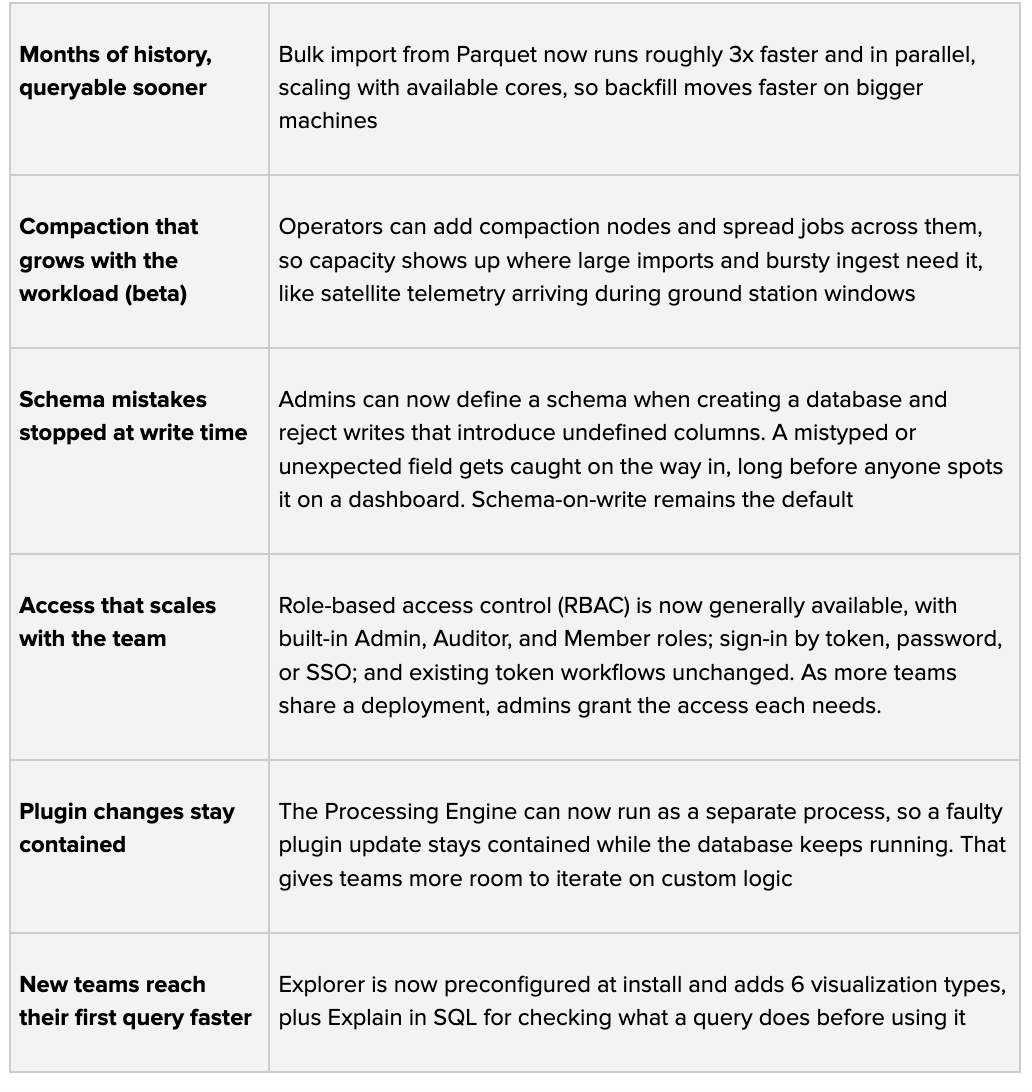
 With RBAC now GA in InfluxDB 3.12, admins manage users, sign-in methods, and roles from one screen
Amazon Timestream for InfluxDB shortens the path from device to database on AWS
For teams building on AWS, device data now has a much shorter trip into InfluxDB. AWS shipped three updates to Amazon Timestream for InfluxDB that take services out of the ingestion path, keep more processing inside the database, and bring it to more of the world:
- Direct ingestion from AWS IoT Core: a built-in InfluxDB rule action converts device data to line protocol and writes it straight to Timestream for InfluxDB or a self-hosted InfluxDB cluster, with no custom ingestion code or intermediate services to build and maintain.
- Custom Python plugins: Timestream for InfluxDB 3 Core and Enterprise now run custom Python plugins through the Processing Engine, so transformations and alerting happen inside the database without a separate pipeline to stand up.
- Eight new AWS regions: including regions in Africa, Asia Pacific, and Europe, so more teams can deploy close to where they need it.
Telegraf Controller 1.1 makes large fleets easier to run and adds Enterprise high availability
Telegraf is easy to stand up, which is exactly why fleets grow from ten agents to a few hundred, and at some point managing them takes more effort than collecting the data. Telegraf Controller 1.1, released August 25, is built for that point. It makes growth easier for every user and gives
Telegraf Enterprise the reliability that production and compliance systems depend on.
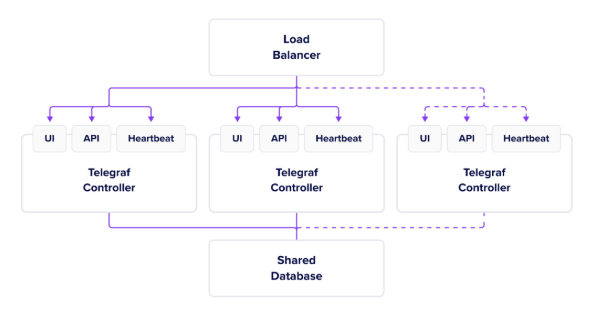
High availability (Telegraf Enterprise). Agents keep pulling configs and reporting health even if a Controller instance goes down. Multiple Controller instances now run against a shared database with automatic failover, and instances can go offline for patching while the config path stays open, so routine maintenance doesn’t interrupt the fleet.
One edit, fleet-wide. Every Controller user gets new ways to grow a fleet without growing the team behind it:
- Global constants: define a value like an output endpoint once, and every configuration referencing it picks up the change.
- Configuration groups: bundle configs into one unit that agents retrieve in a single request.
- Configuration aliases: give configs and groups human-readable names that work across Controllers.
Together, they turn a fleet-wide change into one edit that every site picks up on its next config pull. Configuration versioning records who made each change and makes it reversible, and a side-by-side difference shows exactly what to roll back when an edit goes wrong.
When a fleet outgrows the free version’s limits of 100 agents and 20 configurations, Telegraf Enterprise removes them and adds audit logging, LDAP/OIDC, and official expert support for both Controller and Telegraf. Contact us about Telegraf Enterprise to learn more.
Telegraf 1.40 opens a direct path into Databricks
Telegraf 1.40 adds two new community-contributed plugins, including one that streams metrics directly into Databricks:
- Databricks Zerobus output (
outputs.zerobus) streams metrics into a Unity Catalog Delta table over gRPC through Databricks Zerobus Ingest. - Fritzbox Smarthome input (
inputs.fritzbox_smarthome) reads metrics such as lamp state and energy consumption from FRITZ! smart home routers.
Thank you to zlata-stefanovic-db & hdecarne for building these great plugins! Telegraf’s plugin library has grown one contribution at a time from amazing contributors like you.
Several existing plugins also now report more accurate data and run on maintained libraries:
- Elasticsearch query input: now built on official, maintained libraries, adding support for Elasticsearch v7, v8, and v9.
- Cisco Model-Driven Telemetry: fixes for alias handling, table row tagging, and spurious metrics, with some changing metric formats or names.
- SMART input: power-on-hours now report correctly for raw duration values.
- Deprecated plugins and options removed:
inputs.aerospike,inputs.sflow, andoutputs.amon are gone, along with several deprecated options.Run telegraf config migratebefore upgrading.
A few things people have asked us
Does upgrading to InfluxDB 3.12 require a migration? No, it’s an in-place upgrade. However, multi-node deployments have new requirements for node roles and upgrade order, so review the release notes first.
Is distributed compaction ready for production? It’s in beta and available for evaluation, and off by default, so existing deployments are unaffected until you turn it on.
Looking ahead
Feedback on the distributed compaction beta, and on high availability and configuration groups across Telegraf Enterprise fleets, will shape what comes next. Tell us what’s working and what you’d like to see in the InfluxDB Community Slack.


